
Abolish Points of Information? Doug Cochran’s thoughts on how to improve POIs.
5. Februar 2013 | Von Achte Minute | Kategorie: Das Thema, International
At the World Debate Forum in Berlin 2013, debaters from across the world talked about using debating in tournaments, trainings and youth projects. In the opening speech, Doug Cochran presented “Ten suggestions for a better Worlds”. Among these points, he suggested to abloish or reform Points of Information during BP debates. As these thoughts might interest you aswell, Achte Minute asked Doug to write down his thoughts.
DOUG COHRAN: TWO POTENTIAL REFORMS TO POINTS OF INFORMATION
At the World Debating Forum, there was a discussion about potential reforms to WUDC debating. I put forward a number of suggestions, including abolition of points of information, which I elaborate upon here.
I should point out- as I did when I gave the talk- this is all just a suggestion. As I’m really too old for serious debating, I should reiterate my belief that debating should be whatever its participants want it to be. This is just one idea of something that I think could make it better.
My difficulties with Points of Information are two-fold:
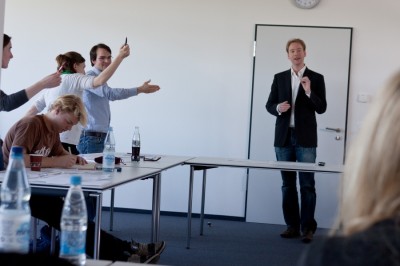
No questions anymore? (c) Manuel Adams
Firstly, they interrupt proper debating, usually for silly reasons. In the course of offering points of information, debaters spend an enormous amount of time bouncing up and down, often with affected sighs or cries of ‘Sir/Madam!’ designed to demonstrate to all assembled that (shockingly!) they disagree with what is being said. It’s rude, it’s off-putting, and experienced speakers are rarely called to order when they do so. Even when speakers are behaving themselves, points of information distract from proper listening as speakers spend their time planning points of information, discussing them with their partners, and standing to offer them. If judges track when POIs are being offered (as they are meant to do) that can only further serve to distract their attention from the flow of arguments. When accepted, points of information often take the speaker off their train of thought and interrupt the flow of a speech (indeed they often do so deliberately).
Secondly, it is nearly impossible to apply sanctions to speakers who do not accept points of information or who accept too few. The traditional sanction is to ‘penalise the speaker as though they had dealt with a good POI very badly’ (or something to that effect). But no judge actually does this, because the standard is nearly impossible to apply. Points of information that are actually answered badly don’t merely count to the discredit of the speaker answering them, they count to the positive credit of a particular team that has offered them. If no POI has been taken, it becomes impossible to apportion that credit. Moreover, POIs don’t merely harm a case in the abstract, they do damage to particular claims, which are more or less important depending on the how the debate has played out thusfar. I have never heard a judge say in feedback that they would have awarded a place to a particular team, but for their failure to accept a point of information- judges with a reputation protect.

(c) Manuel Adams
As I see it, the necessity for points of information arises because the BP would not otherwise allow any direct engagement between teams diagonally across from each other.
One suggestion would be to abolish points of information altogether and replace them with reply speeches, in a format similar to Australasians or Worlds Schools. Reply speeches could be roughly three minutes in length and given by either member of the top-half teams. If necessary, time could be deducted from the other speeches in the debate (shortening each to six minutes, for example) in order to save time. Given that speakers would now no longer have to interact with points of information, it seems reasonable to assume that the loss of the minute will not be very much missed and speakers able to deliver something like the same amount of total content.
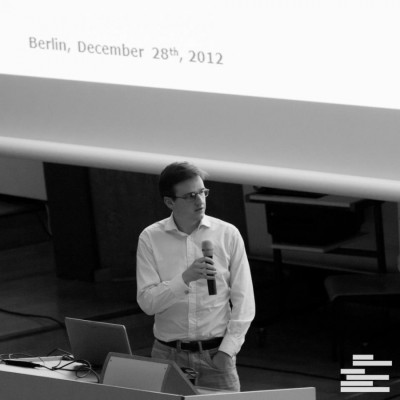
Doug Cochran during WUDC 2013 (c) WUDC2013
A more moderate suggestion would simply be to reform the role of points of information in a way that minimises their capacity to distract and maximises the time spent concentrating on content. My suggestion would be to insert a rule to this effect:
Each team has the right to ask each opposing team one- and only one- point of information. When a speaker rises to offer their team’s point of information, they cannot be declined. Having been accepted, the team that has offered the point may not offer the same team any further points during that debate.
As well as emphasising listening and minimising interruption, this reform would give each team a guaranteed opportunity to offer a point with no risk of being ‘shut out’. Rather than trying to crowd out the other team on the bench by asking whatever comes into their minds, speakers would have an incentive to use their POI carefully and only rise when their question is particularly well-thought-out.
At the World Debate Forum in Berlin 2013, debaters from across the world talked about using debating in tournaments, trainings and youth projects. In the opening speech, Doug Cochran presented “Ten suggestions for a better Worlds”. Among these points, he suggested to abloish or reform Points of Information during BP debates. As these thoughts might interest you aswell, Achte Minute asked Doug to write down his thoughts.
DOUG COHRAN: TWO POTENTIAL REFORMS TO POINTS OF INFORMATION
At the World Debating Forum, there was a discussion about potential reforms to WUDC debating. I put forward a number of suggestions, including abolition of points of information, which I elaborate upon here.
I should point out- as I did when I gave the talk- this is all just a suggestion. As I’m really too old for serious debating, I should reiterate my belief that debating should be whatever its participants want it to be. This is just one idea of something that I think could make it better.
My difficulties with Points of Information are two-fold:
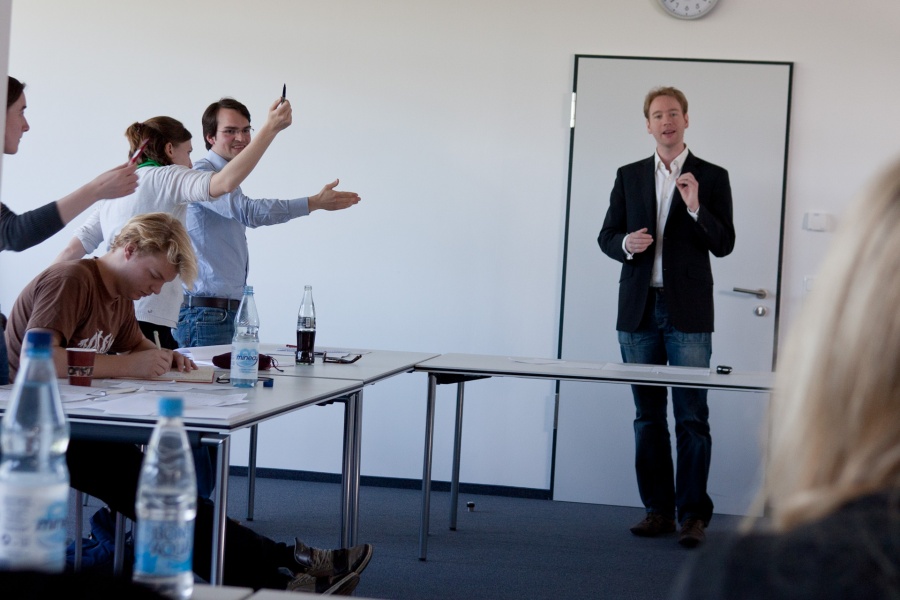
No questions anymore? (c) Manuel Adams
Firstly, they interrupt proper debating, usually for silly reasons. In the course of offering points of information, debaters spend an enormous amount of time bouncing up and down, often with affected sighs or cries of ‘Sir/Madam!’ designed to demonstrate to all assembled that (shockingly!) they disagree with what is being said. It’s rude, it’s off-putting, and experienced speakers are rarely called to order when they do so. Even when speakers are behaving themselves, points of information distract from proper listening as speakers spend their time planning points of information, discussing them with their partners, and standing to offer them. If judges track when POIs are being offered (as they are meant to do) that can only further serve to distract their attention from the flow of arguments. When accepted, points of information often take the speaker off their train of thought and interrupt the flow of a speech (indeed they often do so deliberately).
Secondly, it is nearly impossible to apply sanctions to speakers who do not accept points of information or who accept too few. The traditional sanction is to ‘penalise the speaker as though they had dealt with a good POI very badly’ (or something to that effect). But no judge actually does this, because the standard is nearly impossible to apply. Points of information that are actually answered badly don’t merely count to the discredit of the speaker answering them, they count to the positive credit of a particular team that has offered them. If no POI has been taken, it becomes impossible to apportion that credit. Moreover, POIs don’t merely harm a case in the abstract, they do damage to particular claims, which are more or less important depending on the how the debate has played out thusfar. I have never heard a judge say in feedback that they would have awarded a place to a particular team, but for their failure to accept a point of information- judges with a reputation protect.

(c) Manuel Adams
As I see it, the necessity for points of information arises because the BP would not otherwise allow any direct engagement between teams diagonally across from each other.
One suggestion would be to abolish points of information altogether and replace them with reply speeches, in a format similar to Australasians or Worlds Schools. Reply speeches could be roughly three minutes in length and given by either member of the top-half teams. If necessary, time could be deducted from the other speeches in the debate (shortening each to six minutes, for example) in order to save time. Given that speakers would now no longer have to interact with points of information, it seems reasonable to assume that the loss of the minute will not be very much missed and speakers able to deliver something like the same amount of total content.

Doug Cochran during WUDC 2013 (c) WUDC2013
A more moderate suggestion would simply be to reform the role of points of information in a way that minimises their capacity to distract and maximises the time spent concentrating on content. My suggestion would be to insert a rule to this effect:
Each team has the right to ask each opposing team one- and only one- point of information. When a speaker rises to offer their team’s point of information, they cannot be declined. Having been accepted, the team that has offered the point may not offer the same team any further points during that debate.
As well as emphasising listening and minimising interruption, this reform would give each team a guaranteed opportunity to offer a point with no risk of being ‘shut out’. Rather than trying to crowd out the other team on the bench by asking whatever comes into their minds, speakers would have an incentive to use their POI carefully and only rise when their question is particularly well-thought-out.
This last suggestion is even worse if you believe the background Doug provides. Trust me, I could do a lot of damage if I was given the guaranteed right to disrupt an opposing speaker's speech whenever I felt like, and he was compelled to stop his flow of argument and answer my question is instead. This would also generally reduce the quality of debates tremendously.
ReplyDeleteReply speeches (if all teams had a right to make them) might provide some kind of an improvement to the joke that this format is. As it is, you can't possibly be saying the format is both fair as it is, and would also remain balanced if two teams got 3 minutes of additional speaking time.
Sadly Worlds is just competitive elocution where you compete to make the most obvious arguments imaginable with the slow, measured Australian style of speech, where whoever makes the least number of notable mistakes tends to win thanks to the way adjudication works. It doesn't have to be this bad, but a combination of the way the circuit works and the inherent stupidity of having 4 teams in a competitive debate round render this a farce.